
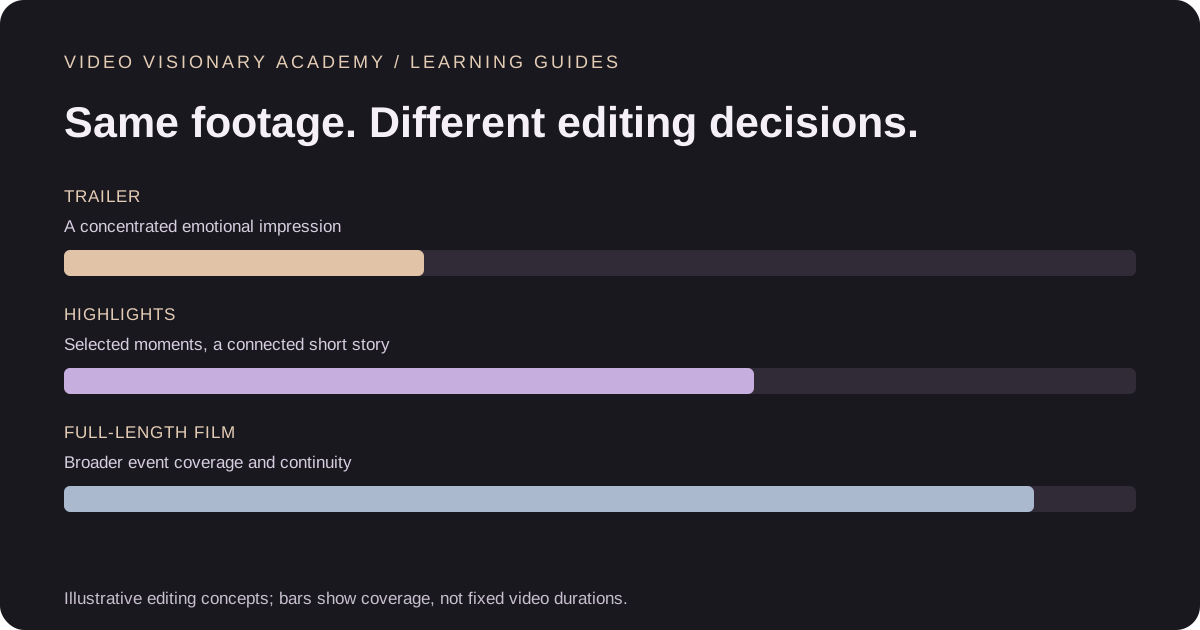
The difference in one paragraph
A wedding trailer creates a concentrated impression of the couple and celebration. A highlights film brings together selected moments to tell a more complete short story. A full-length wedding video preserves broader event coverage and continuity. A pre/post-wedding song edit organises a film around a musical structure and the available couple footage. Names and expected lengths vary, so agree the deliverable before editing.
Wedding trailer: give every moment a purpose
A trailer does not need to show every event. Begin by deciding the feeling you want to communicate: intimacy, energy, anticipation or celebration. Select moments that support that direction, rather than putting every attractive shot into the timeline.
For example, an opening might connect a quiet detail with a meaningful reaction, followed by a change in musical energy. The question is whether each cut develops the feeling. A transition is useful when it supports that movement; it cannot replace a missing story.
Review the edit without relying only on its strongest visual effects. Can someone unfamiliar with the wedding understand who the film is about and what the emotional direction is?
Highlights: choose a story across the celebration
A highlights film has room to connect more of the celebration’s meaningful moments. Selection still matters: the goal is not simply to shorten a full-length edit by removing random sections.
Build a structure from the footage you actually have. A reaction may connect one sequence to the next; a spoken moment may give context to an image; an energetic section may need a quieter passage afterward. Keep the couple and event understandable as the film moves between moments.
Full-length wedding video: protect continuity
A regular full-length edit usually needs broader coverage than a trailer or highlights film. Organise media so that events, cameras and usable audio are easy to identify. Check continuity before spending time on decorative effects.
Pay attention to moments where missing context could confuse a viewer. A visually polished shot does not compensate for an important sequence becoming difficult to follow. Review audio changes as carefully as picture cuts, and check that colour treatment remains consistent across adjacent shots.
Pre/post-wedding songs: follow musical structure thoughtfully
A song edit can be shaped around changes in musical energy, repeated sections and pauses. That does not mean every shot needs a cut on every beat. Contrast and breathing room can help the imagery remain expressive.
Review the available footage before choosing an editing pattern. Check whether movement, composition and location changes connect naturally. Confirm that the music and footage you use are authorised for the intended delivery or publication.
Where colour grading fits
Colour work should support the edit. First aim for a coherent sequence: neighbouring shots should not feel unintentionally disconnected. Then develop a creative treatment that suits the footage and the film’s direction.
Apply a look with care across different lighting conditions. A treatment that works on one shot may need adjustment on the next. Review the finished sequence as a whole, including faces and important details, rather than judging only a single attractive frame.
Match the deliverable to your learning path
- 45 teaching days: wedding trailers and colour grading.
- 60 teaching days: trailers, pre/post-wedding songs and colour grading.
- 90 teaching days: full-length weddings, trailers, highlights, songs, advanced colour grading and real-work practice.
All three programmes welcome beginners. Classes are one hour Monday–Friday, online or offline. Compare the durations, fees and class hours before choosing.
About this guide
Published by Video Visionary Academy. Programme details reflect the academy’s confirmed information as of 19 October 2026. Editing examples are illustrative; exact deliverables vary by project. Contact the academy to confirm batch availability and enrolment terms.
Meet the instructor ↗